
A Call to Transform the Education System
From Compliance to Liberation


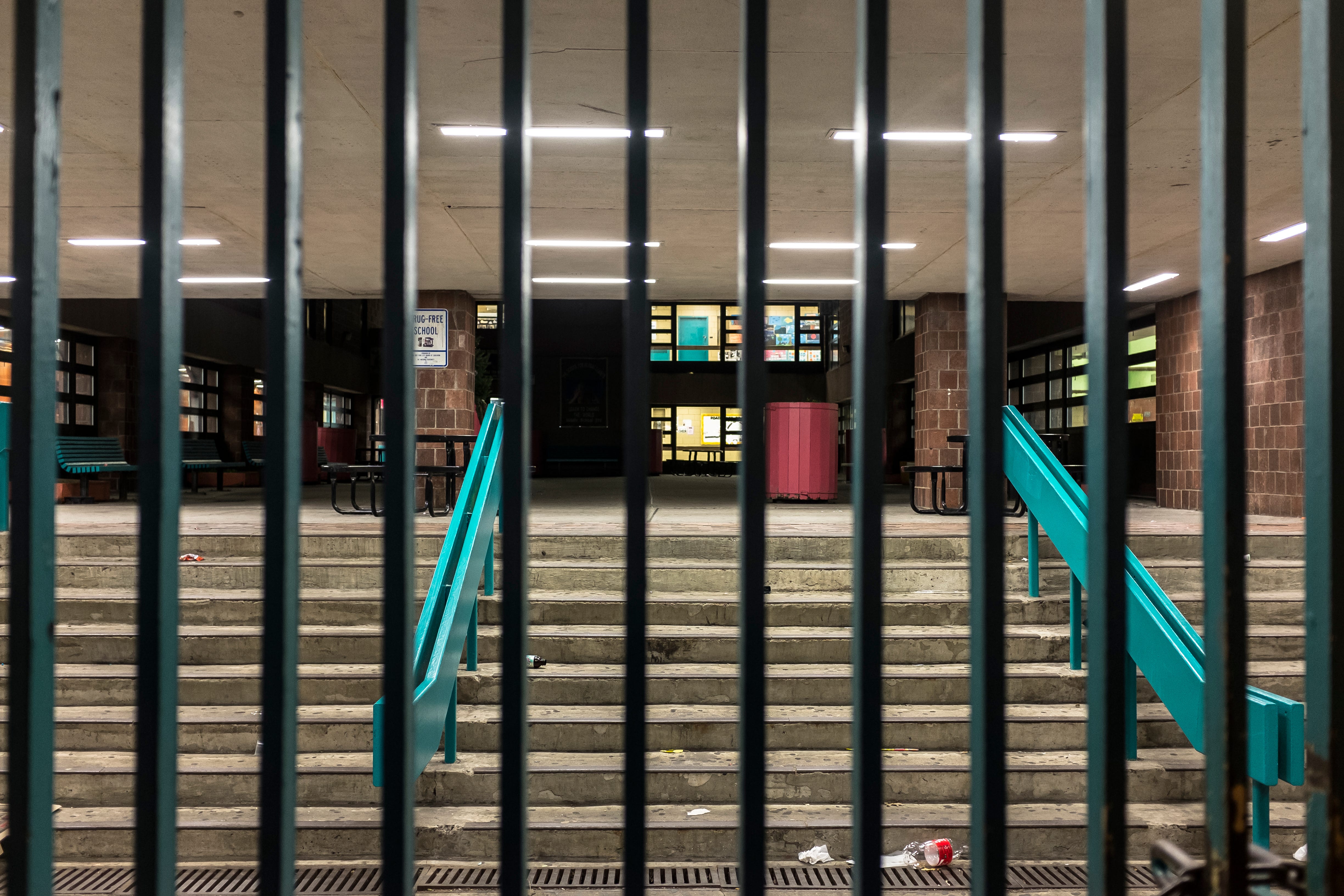
‘To Academy or Not to Academy?’ Isn’t the Question
Back in 2002, we were introduced to the UK’s first academy. An optimistic Labour government claimed that the independently-managed schools would raise educational standards, “provid[ing] centres of educational excellence in deprived, urban areas” (BBC 2002). Since its inception, we’ve witnessed the unmitigated proliferation of academies across the UK, constituting 43.5% of schools in the 2023/24 academic year (Brader 2025). Nearly half of all UK schools have the power to implement a unique curriculum, set their term times, and determine the length of school days individually or across academy chains. This move, let’s call it the marketisation of schools, has resulted in a growing business-like approach to their management. Coupled with ongoing austerity measures, young people’s education is increasingly financialised at the expense of real access to quality education.
This particular matter, whether or not to academise, doesn’t really challenge the financialisation of education at its root. ‘Academisation’ is ultimately a question of management or, in other words, how schools are run. Through this lens, we can question the extent to which academisation financialises education, but in doing so, we are restricted from interrogating the financialisation of education itself. Instead, we can dig deeper and uncover new solutions by viewing the education system as a legacy of British imperialism.
Used as a tool to impose control and ideological dominance across the colonies, education was a key part of the imperial ‘civilising mission’. In the current postcolonial era, the education system continues to be underpinned by this imperial ideology. As such, schools emerge as centres of postcolonial compliance. Here, academic success is significantly defined by the extent of pupils’ behavioural, social and cultural assimilation into the White middle class (Class 13, 2025). By acknowledging this systemic violence perpetrated by schools, we can collectively work towards transforming the landscape of education. Departing from centres of surveillance and control, schools have the potential to become sites for collective liberation.
Postcolonial Compliance as the Logic for Success
Deviation from the White middle-class identity leads to a disproportionate rate of exclusions, and this notably increases where these identities intersect (McCluskey et al. 2024). Such punitive responses to so-called ‘bad behaviour’ contribute considerably to what is known as the ‘school-to-prison pipeline’ (Prison Education Trust 2022). Despite the abundance of evidence that highlights this link between individual identity, experience of the education system, and experience with the criminal justice system, punitive behaviour management remains the norm in schools.
As social, cultural and economic hierarchies are mirrored and reproduced in schools, a significant extent of students’ success is determined by the degree to which they assimilate into the dominant way of being. The demand for assimilation is not limited to pupils marginalised based on race or ethnicity. Rather, neurodiverse pupils and those of low-income families are also subject to disproportionate punitive behaviour management. As these identities intersect, the pupil exists further from the dominant social and cultural norms and so suffers greater punishment on their longer path to assimilation. The damaging effects of punitive behavioural management are broadly understood, so this begs the question: why do schools continue to persist with such measures?
Punitive behaviour management remains an important force as, now more than ever, the education system demands schools’ control over their students; control over students means control over outcomes. The system functions in such a way that schools take up a business-like approach with families as their consumers (Harris 2023). As a result, to offer the ‘best’ service possible for upcoming families, schools require a tight grip over their students and their performance. Bolstered by the academisation programme, control goes beyond a school’s response to behavioural transgressions and cements itself within the ideological foundation. There is a carceral logic of schooling that permeates throughout the institution (Class 13 2025). From zero-tolerance behaviour policies, curriculum content, assessments (of both pupils and schools), through to the school’s very architecture, quantifiable results emerge as the primary indicator of success. Therefore, not only are so-called ‘troublemakers’ increasingly problematised, but schools are ultimately governed by their ability to exert control and reproduce existing social, cultural and economic hierarchies.
So it is clear, then, that the question of academisation becomes irrelevant if we want to overcome the financialisation of education at its core. The resultant inequities, reproducing existing hierarchies, cannot be remedied by the existing measures of success. This cycle, where schools not only mirror inequities but actively reproduce them, must be broken through long-term strategies that transform the ideological foundation from postcolonial compliance to liberation (Class 13 2025). And there is no such thing as a blanket solution. While schools may share the same ideological foundation, the ways and degrees to which inequities persist are contingent upon the particular circumstances of any given school.
Transformation is Liberation
As the path to ideological transformation is unique for each institution, schools must initially develop a deep understanding of their internal inequities: superficial understandings of inequities, typically obscuring intersectional analyses, risk adopting responses governed by a carceral logic. Such responses overlook the systemic nature of inequities, failing to address issues at their root. Therefore, schools end up delegating more time, people and resources to administering short-term solutions that drive up per-pupil spending. A long-term commitment to transformative change, on the other hand, underpins and guides a school’s development. From teacher training to awareness days and curriculum content, schools will be able to weave equitable solutions throughout their operations. These solutions would be founded upon an acute understanding of its position relative to its various community members. Whether that be students, educational staff or parents and carers, unearthing inequities can enhance intergenerational connections and inform solutions.
Education as liberation from postcolonial compliance is to reimagine what schools do. With growing demands for teachers, it is becoming increasingly unreasonable to expect them to effectively address existing inequities. By harnessing the power of intergenerational connection, there is scope to democratise education through the co-creation of bespoke solutions for schools. To take such a step would be to resist the financialisation of education in favour of access to quality education. Long-term transformation that centres pupils will foster stronger relationships, reduce punitive measures, improve mental health and even attainment. The emphasis on punitive behavioural management that has disproportionate, prejudiced outcomes stands as a strong indicator that equity in education should be placed at the forefront of schools’ minds. While government policy dances around academisation, we’re looking ahead towards total transformation.
Dyar
Sources:
BBC. (2002). Academies warning from head teachers [online]. Available from: http://news.bbc.co.uk/1/hi/education/2246919.stm [accessed June 2025].
Claire Brader. (2025). Academy schools: Government plans for change [online]. Available from: https://lordslibrary.parliament.uk/academy-schools-government-plans-for-change/ [accessed June 2025].
Class 13 (2025). An Argument for Possibility [online]. Available from: https://www.class13.org/wp-content/uploads/2025/04/An_Argument_for_Possibility_Class13_2025_Optimised.pdf [accessed June 2025]
Dawson, D. (1982). Educational Hegemony and the Phenomenology of Community Participation. The Journal of Educational Thought [online], 16(3), pp.150-160. Available from: https://www.jstor.org/stable/23768315 [accessed June 2025].
Harris, D. N. (2023). How Free Market Logic Fails in Schooling—And What It Means for the Role of Government. Educational Researcher, 53(2), pp111-122. Available from: https://doi.org/10.3102/0013189X231216953 [accessed June 2025]
Martindale, N. (2019) ‘Does outsourcing school systems degrade education workforces? Evidence from 18,000 English state schools’, British Journal of Sociology of Education, 40(8), pp. 1015–1036. doi: 10.1080/01425692.2019.1647092.
Martindale, N. (2022) ‘Austerity, outsourcing and the state school workforce: trends from 20,000 English state schools’, British Journal of Sociology of Education, 43(3), pp. 451–474. doi: 10.1080/01425692.2021.2018650.
McCluskey, G. et al. (2024) ‘School exclusion policies across the UK: convergence and divergence’, Oxford Review of Education, 50(6), pp. 760–776. doi: 10.1080/03054985.2024.2376609.
National Education Union. (2024). The NEU case against academisation [online]. Available from: http://neu.org.uk/advice/your-rights-work/academisation/neu-case-against-academisation [accessed June 2025].
Prisoners’ Education Trust. (2022). Stopping the neglect of children caught up in the criminal justice system [online]. Available from: https://prisonerseducation.org.uk/2022/03/stopping-the-neglect-of-children-caught-up-in-the-criminal-justice-system/#:~:text=The%20school%2Dto%2Dprison%20pipeline,old%20when%20last%20at%20school [accessed June 2025]